
S.A.M.E.R. Project
School`s Ability to Adapt in the Modern Educational Context:
NAVIGATING THE RESILIENCE
Schools today operate in an environment of accelerating change. Technological disruption, growing socioeconomic inequalities, the mental health crisis among young people, and the structural shocks of events such as the COVID-19 pandemic have fundamentally altered the conditions under which educational institutions function. The pandemic in particular demonstrated, at systemic scale, both the fragility and the latent adaptability of schools: institutions that had invested in organisational capacity, collegial trust, and community relationships adapted; those that had not, struggled.
Furthermore, the digitalization of school materials and development of AI lead to homogenization of the teaching conditions and challenges schools face across the world – making cooperation and coordination somewhat a practical necessity. This at the same time means that schools, across the globe will be facing changes that will have impact on how the teaching process is perceived, as well as how the schools` function is perceived. This moment brings about the notion of resilience as preserving an “organisational identity ( and function that is) stable enough to be strengthened”. Schools will want to embrace changes, to adapt but at the same time not lose their essence.
The need for structured, evidence-based tools to help schools assess and strengthen their own resilience is well-documented in the international literature. Yet the existing landscape of school self-assessment instruments, at the moment, is fragmented: tools tend to focus on a single dimension (crisis preparedness, or teacher wellbeing, or community engagement), to be designed for external evaluation rather than internal reflection, or to be developed for high-income systems that differ substantially from the contexts in which SAMER partners operate. No existing tool integrates the full range of dimensions that determine a school’s capacity to adapt, across the multiple respondent groups whose perspectives matter.
The SAMER self-assessment tool is designed to fill that gap. It is a structured, modular, internally-administered instrument that gives school communities — managers, teachers, support staff, and students — a shared, evidence-grounded picture of where their institution stands on six dimensions of resilience, and actionable guidance on where and how to improve. It operationalises the project’s commitment to the Erasmus+ priorities of well-being, digital transformation, inclusion, and non-discrimination.
Target audience and scope
– Who the tool is for
The SAMER self-assessment tool is designed for primary and secondary schools in any European context, with particular relevance for schools that have experienced or anticipate significant organisational, technological, or social disruption. The tool is suitable for schools of all sizes, from small rural schools to large urban institutions with several hundred staff.
The tool is positioned explicitly as an internal self-assessment instrument, not an external audit or inspection tool. Its purpose is to support structured reflection and informed planning within the school community, not to produce a performance ranking for external accountability. This distinction is central to the design: schools that feel safe to report honestly receive more useful results than schools that feel evaluated.
– Who should complete the assessment
The assessment is structured around two distinct respondent groups, each of which completes a version adapted in language, scale, and depth to their role and age:
Teachers and School Staff — all teaching staff, administrative, support, and non-teaching staff: secretaries, school psychologists or social workers, librarians, IT coordinators, facility managers, and similar roles.
• Students
The two-group structure is deliberate. Research consistently shows that management practices look different from a teacher’s perspective than from a student’s perspective; that teachers assess school culture differently than support staff; and that students are the most sensitive detectors of whether inclusive practice is real or cosmetic. A tool that asks only one group produces a partial and potentially misleading picture.
The six-dimension framework
– Overview
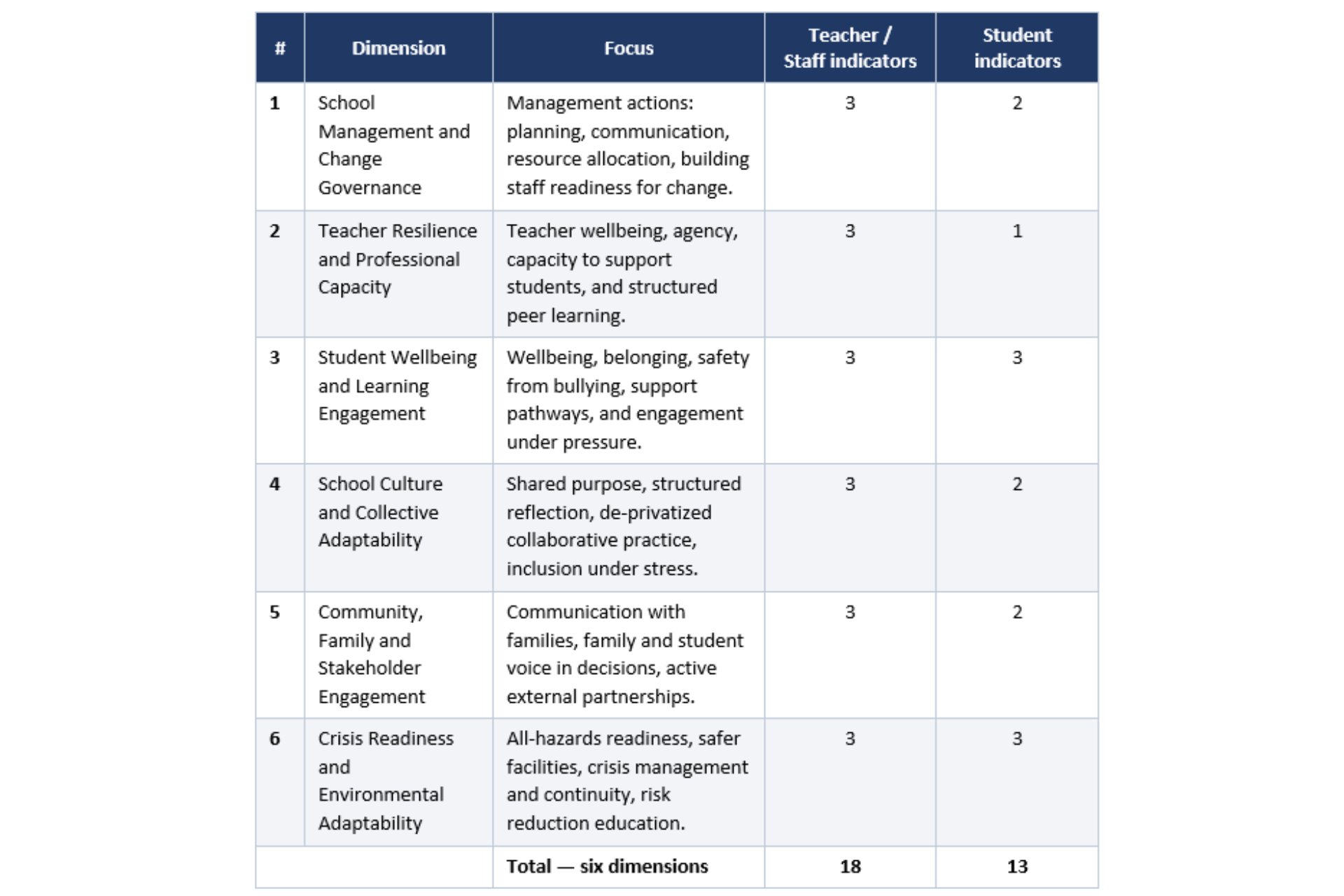
The assessment is organized around six dimensions of school resilience, identified through the systematic scoping review of 43 international sources conducted in Activity 2.1. Each dimension represents a distinct, independently assessable area of institutional capacity. Together, the six dimensions provide a comprehensive picture of the school’s ability to navigate change while maintaining educational quality.
Recommendations and follow-up actions
– Logic of the recommendation system
Each dimension at each level is linked to a structured set of recommendations. The architecture is designed so that recommendations are specific to what the school’s result actually tells us — not generic best-practice advice that could apply to any school at any level.
– User journey
The assessment follows a structured four-step flow for each respondent. All steps are accessed through the same online platform; no installation is required.
Step 1 · School profile and respondent registration
Before any respondent begins the assessment, they should create a profile.
Step 2 · Assessment introduction
Each respondent sees a brief welcome screen that explains the tool’s purpose, the response scale, the difference between ‘I don’t know’ and ‘Not relevant’, the estimated completion time, and the data use and privacy statement. The screen also explains that there are no right or wrong answers and that the data will be aggregated: individual responses are not visible to the school management.
Step 3 · The assessment
The respondent moves through the six dimensions in sequence, though they may save progress and return. Each dimension begins with a brief contextual introduction (three to five sentences), then presents the items for that dimension. Items are displayed one per screen for the student version and in small grouped sets for the teacher and staff version. A progress indicator shows how many dimensions have been completed.
Step 4 · Results and recommendations
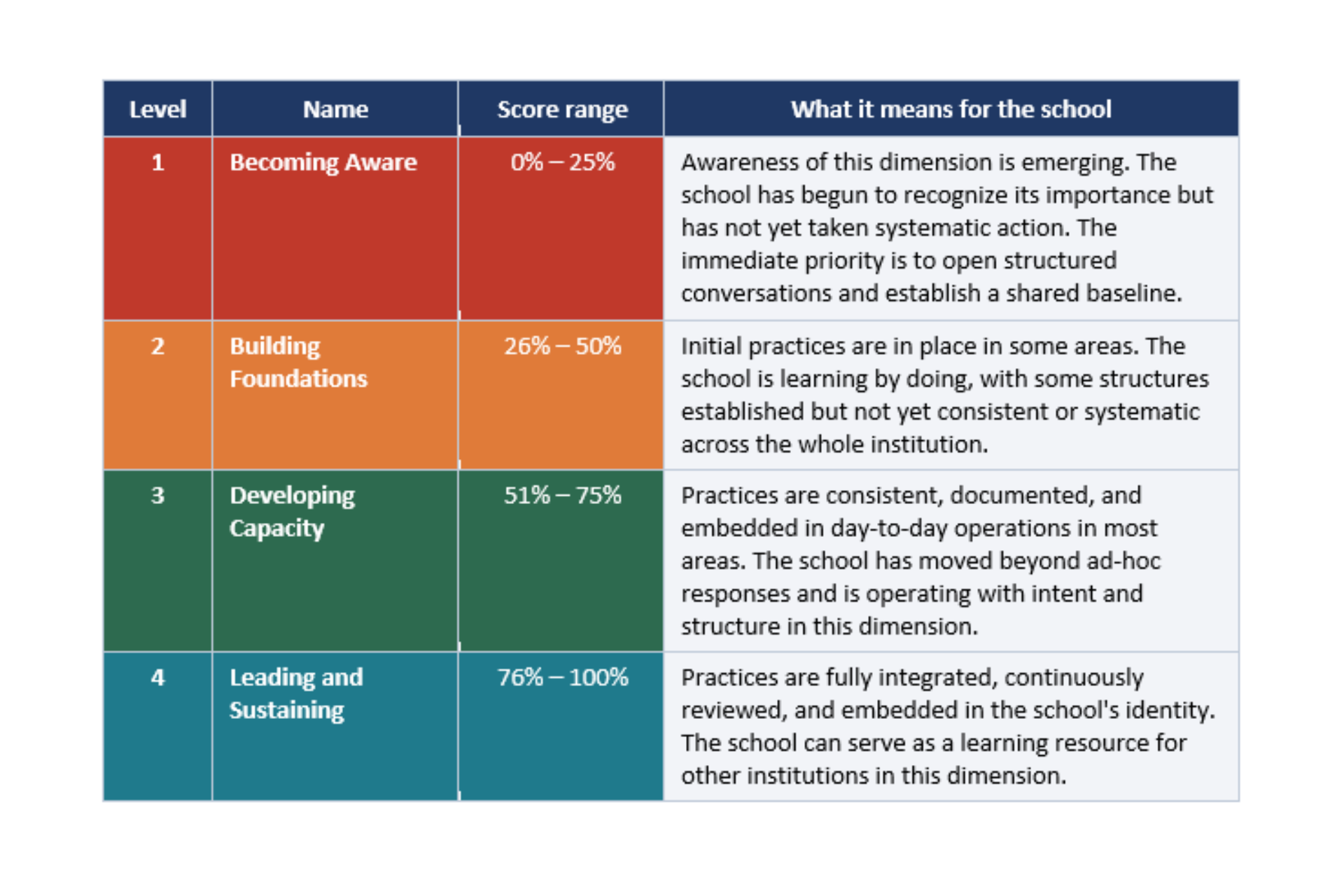
Once all dimensions are complete, the respondent sees their personal results page: a six-segment profile diagram (one segment per dimension, coloured by the level achieved), followed by the interpretation, framing, and next–step recommendations for each dimension. The respondent can download a PDF summary which includesthe six-dimension profile diagram (coloured by level), the interpretation and next-step recommendations for each dimension, and — where available — a benchmarking comparison.
Search for posts
Calendar

 Western Balkans Circular Economy Awards 2026